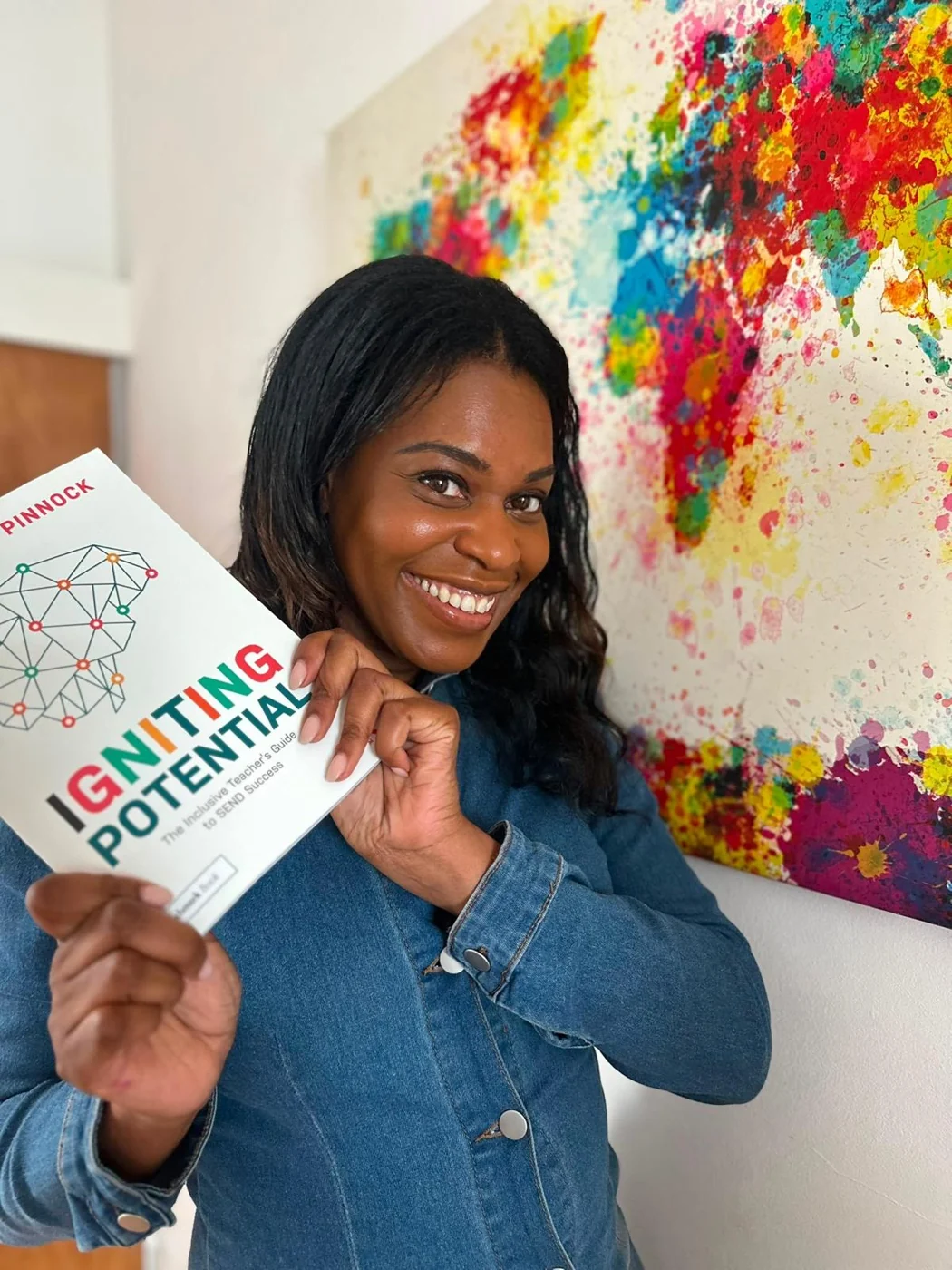
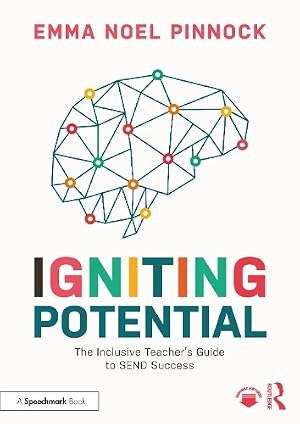
The Inclusive Teacher’s Guide to SEND Success, by Emma Noel Pinnock.
Igniting Potential · Routledge / Speechmark
Routledge / Speechmark · First edition
Inclusive practice. Classroom possibility.
The publisher describes a guide bringing together practical strategies with insights from psychology and neuroscience to help teachers understand SEND learners and develop confidence in the classroom.
The themes connect the whole learner with teaching, regulation, motivation and inclusive educational practice.
Emma reflects on potential, belonging and the questions behind her book.
Emma Noel Pinnock · Author recording
Read transcript draft
Prepared from supplied audio for editorial review, not a verified timed caption track.
Speaker 1: So this is a little video about why I wrote Igniting Potential. Igniting Potential was a title I came up with because I feel that we miss so much of the potential of our children who think, learn, and experience our world differently. And so my premise of the book is that we haven't quite found all of the levers to pull to really ignite the potential in our young people. Now Igniting Potential isn't about normalizing children or letting children achieve exactly like their peers. It's about recognizing where our children are that have additional needs, and how can we ignite more of their potential so that they can connect with the world and feel that they belong. They can connect with the world and know that they are purposeful and can contribute and be citizens of their world. And I think sometimes what happens because of our systems at the moment not fully understanding our children, they fall, they fall out of all of that. You know, one of the things I'm really passionate about is the fact that we have no route in education for our children who think and learn and experience the world differently. If our child is typical, they may go onto school, into college, into university, etc., etc. and into a life that will always have challenge because that's life, but without as much challenge as our children with additional needs. And what I'm passionate about is have we created the right routes for those who learn and think differently. So the premise of the book is that, basically I'm starting off the conversation about a SEND pedagogy. Do we have one? And if we don't have one, what could it look like? So in the book you'll see that I've had—I've got lots of philosophical questions, and if you know me personally, that was going to be the case. Lots of philosophical questions, but I've also got some very, very practical things about how we support our children who think, learn, and experience our world differently. So I hope that you get this message from Igniting Potential. You can order it on Routledge or Amazon, and I look forward to hearing more about what you think.
Book · 1:38
Regulation, motivation and engagement
Three ideas Emma introduces in her book.
Emma Noel Pinnock · Author recording
Read transcript draft
Prepared from supplied audio for editorial review, not a verified timed caption track.
Speaker 1: Hi! By now I hope you've got your copies of Igniting Potential, and if you haven't you're on the way to buying one. I thought in this video I'd share three practical tips that I really share in the book. One of the things that I actually highlight in the book is a model, a model for Igniting Potential, a model for responsivism. And you'll hear about that in the book if you want to read it a little bit more, but in this responsivism it's about understanding that we know that learning is not linear, but actually the prerequisites of learning are. And I'm not going to go into too much detail because you have to read them in the book. But we have to think about our children's bodies. We know that we need to regulate our children. Our bodies need regulating before we can learn. Once we've regulated, do we know how to motivate? And once we've motivated, do we know how to engage? So these are three of the main tips that I really use in the book. I'm talking about how we support the regulation of bodies that are not typical, and then how do we create motivation, and engagement to support that. For me, RME, which is what you'll hear in the book when you read it, is such an important element of making sure that our children can ignite their own personal potential. Have we got the ingredients correct for regulation, motivation, and engagement? And if you're questioning that, this book is definitely for you. It's time to get it.
Book · 2:09
A message to leaders
Emma discusses the leadership perspective behind her writing.
Emma Noel Pinnock · Author recording
Read transcript draft
Prepared from supplied audio for editorial review, not a verified timed caption track.
Speaker 1: Hi, I hope that you have got all of your summer reading going and that if you're on a beautiful beach somewhere with your preferred beverage that you are Igniting Potential in your thoughts with this book. And I just wanted to pop up really to say, who is this book for? A message to leaders in particular. So the book is obviously called Igniting Potential: The Inclusive Teacher's Guide to SEND. And that was particularly, that was specifically done because we were originally focusing on confidence and teacher confidence. But when people read the book, they'll realize that I've come at it from many different angles. From my angles of being a teacher in the classroom with children with SEND and beyond, and the angle of me being in leadership, running autism resource bases, supporting in my own business now, The Essential Education Group, and supporting leaders. So there's lots of elements in this book that is just purely for educators. I'm not focused about if you're in the classroom or not, I'm talking about a whole system change. This book is about culture. This book is about cultural change. It's about the systems we put in place. Do the systems that we have in place serve our school community, our whole school community, including our children who think, learn, and experience the world differently. And so the message for leaders in this is that please do not think that this book is for your classroom teachers only. This book holds so much rich data about how we can structure our curriculums, it's about the pedagogy of SEND, and it's around how we can structure how our school responds to our unique learners, and that's definitely a leadership conversation.
Original recordings, selected for this private review. Embedded graphics and credits are retained. Recording-era promotional wording is not a statement of current availability.

 Igniting Potential · Routledge / Speechmark